
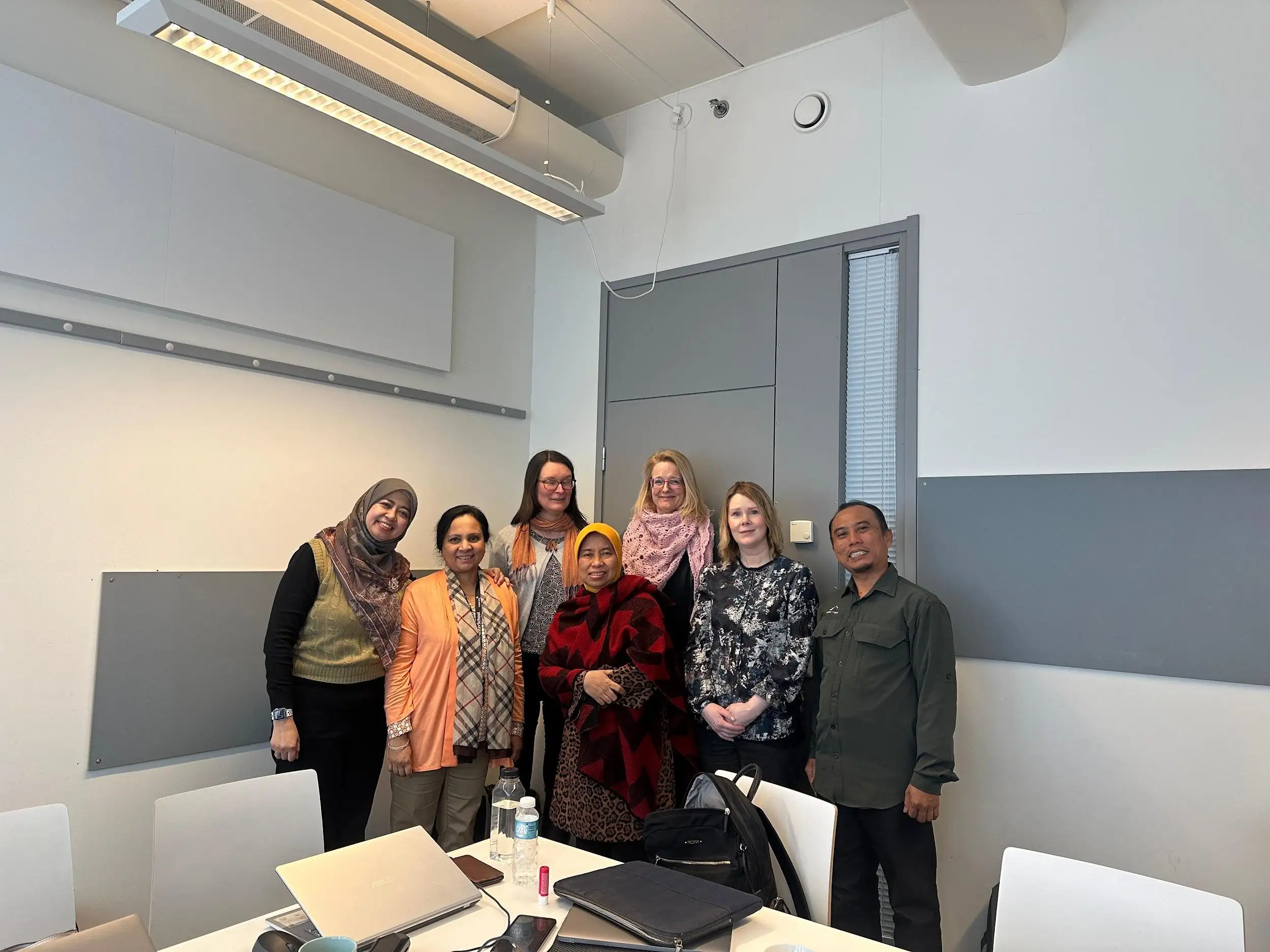
Students and teachers were sent to different rooms to have separate sessions of discussion. The students’ session was led by Ass. Prof. Nelli Altonen who started the session with a brief presentation on the general task for students and the importance of publications for the joint project. Nelli explained the different types of publications, especially the semi-formal and non-formal type of publications such as writing an article on websites and posting on various social media platforms. The main goal is to spread the word of awareness regarding planetary health and let the project be well-known to the rest of the world in the hopes of inspiring other institutions with the same focus. Students were given an article example which was written and published by Nelli in the Linkedin platform as a stimulation for future writing ideas. She then gave a guide of what and how to write, along with ideas and examples of possible topics to write about, displayed through the excel file shared on the google teams channel. The most important part of the presentation was about the communication plan between the Indonesian and Finnish teams after the visit for the entirety of the project.
Teachers Session
 The session commences with a presentation by Britt-Marie Haahti, outlining the future plans for cooperation. Attendees engage attentively as they gather insights into upcoming collaborative efforts and strategic directions. Britt-Marie’s presentation lays the groundwork for a focused discussion aimed at charting the course ahead.
Subsequently, attention turns to exploring potential funding avenues. Participants deliberate pragmatically on securing financial support from Erasmus, the Finnish Government, and other relevant sources. The discussion is marked by a concerted effort to identify actionable strategies for sourcing funds and seeking inspiration for future projects.
Anu Raunio, the International Office Coordinator, then provides valuable insights into the mobility program and funding prospects. With meticulous detail, she outlines available resources and offers guidance on effective budgeting practices. Attendees benefit from her expertise, gaining clarity on funding options and budgetary considerations essential for project planning.
As the session concludes, participants depart with a clearer understanding of the opportunities and challenges ahead. The formal report reflects the substantive discussions held and the actionable insights gained during the session. With a commitment to leveraging available resources and strategic planning, attendees are poised to advance cooperation initiatives effectively in the pursuit of shared objectives.
Visit Associated Partner, University of Turku
University of Turku is one of the listed universities in Turku, which we as the participants from University of Indonesia and Turku University of Applied Sciences have to come to see. University of Turku or in Finnish it is called as “Turun Yliopisto”, actively streaks up academically since 1920 and has 250.000 students and personnel in total in 2024. The most iconic motto of the University of Turku is “Vapaan Kansan Lahja, Vapaalle Tieteelle” means “Free gift of people is to give a free science”. University of Turku itself has eight faculties, those are; faculty of education, faculty of humanities, faculty of law, faculty of medicine, faculty of science, faculty of social sciences, faculty of technology, and Turku school of economics.
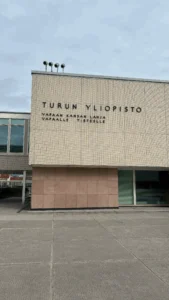
University of Turku Main Building
Here in the University of Turku we were accompanied by Professor Manu Tamminen, a lecturer in the Biology Department of Science Faculty at University of Turku, who is also the husband of Professor Tuuli from Turku University of Applied Sciences. We came to see some educational facilities, specifically the facilities in the science building. There were a variety of facilities including the integrated classrooms, numerous laboratories (both the non hazardous non experimental and the the hazardous experimental laboratories), cafeterias with wide selections of sustenance, and the many different spots for students to study. The building was already fully equipped with accessibility facilities that made it standardized for disability friendly campus. We also felt delighted to see an eye catching illustration about planetary health here in University of Turku, which appeared below;
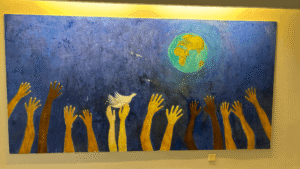
Illustration about Planetary Health in University of Turku
The tour ended with a visit to the Zoological Museum of Turku University. Inside there were various aerial, land, and oceanic species native to Finland as well as the Baltic Sea. The display also included the different phases of the animals throughout different seasons, which demonstrated the adaptive aptitude of the animals. Many species changed their appearance or skin/fur colors to have better camouflage ability during certain seasons. It was interesting to see how different the specieses are compared to the ones in our home country with a more tropical note. The animals are vastly different in colors, patterns, and have different attributes attached to them. Below the taxidermy display was a more intricate anatomical details exhibition of different animals ranging from the specific anatomical attribute of birds that made it possible for them to fly to the special organs of the deep sea creatures. Afterwards we were guided to go through connected buildings to exit the university.
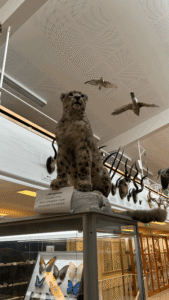
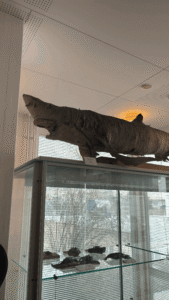
Zoological Museum of The University of Turku
After spending our lovely time at University of Turku, we were invited to spend the afternoon at Prof. Tuuli and Prof. Manu’s house, which was near campus, to get to know Finnish culture and attraction as well as to get the feel of the average Finnish home designs, structures, and attributes. The standard Finnish home would usually have the sauna installed as it is a huge part of the Finnish culture. Another interesting thing is the naturally cold storage room down in the basement as extra storage of food and beverages for daily use or for party purposes. We were also introduced to a traditional Finnish drink and desserts which were really refreshing. The visit ended with the tour of the garden to see the variety of plants typically grown in Finnish homes. The group then bid farewell and headed back to the hotel.
Key Messages
Looking back at the day, there were several things that could be taken as a learning curve for both the Indonesian Team and the Finnish Team. During the student session both of the teams learned to have effective and efficient communication despite the language or distance barrier in order to reach the goal of raising the Planetary Health issue awareness. Meanwhile, teachers were sharing strategies on further funding for the project as well as doing a roadmap to plan future direction of the program. Moreover, after seeing numerous forms that the Turku University raise the issue of Planetary Health, we learned that raising awareness about Planetary Health came from raising awareness within ourselves by incorporating the soul of preserving Planetary Health into everything we do, including in our study and daily living.